Best Business Email Hosting for Startups in 2026 (Compared & Ranked)
We compared the top business email hosting platforms for startups on pricing, multi-domain support, deliverability, and storage — including Razix, Google Workspace, Zoho Mail, Migadu, and more.
Picking a business email provider feels like it should be a five-minute decision. It rarely is. Most startups either overpay for per-seat plans they don't fully use, or underpay for a forwarding tool that quietly breaks their deliverability the moment they reply to a client.
We compared the most popular business email hosting options on the four things that actually matter for a startup: pricing model, multi-domain support, deliverability tooling, and storage — not just feature checklists.
Here's the short version, followed by the full breakdown.
Quick Answer: Top Picks by Use Case
| If you need... | Best pick |
|---|---|
| Flat-rate pricing across multiple domains/products | Razix |
| Enterprise-grade docs/calendar suite, budget isn't a concern | Google Workspace |
| Familiar Outlook/Exchange ecosystem | Microsoft 365 |
| Budget option with a dated UI you can tolerate | Zoho Mail |
| Developer-friendly flat-rate alternative | Migadu |
| Cheapest possible cPanel-based hosting | MXroute |
| Just need forwarding, not a real inbox | ImprovMX / Forward Email |
1. Razix — Best Overall for Startups Running Multiple Domains
Starting at $29/mo · 3 domains, 10 mailboxes, 25,000 emails/mo
Most "startup" email comparisons assume you're running one company on one domain. In practice, a huge share of founders are running multiple products, brands, or client domains at once — and that's exactly where per-seat pricing from the big providers becomes brutal.
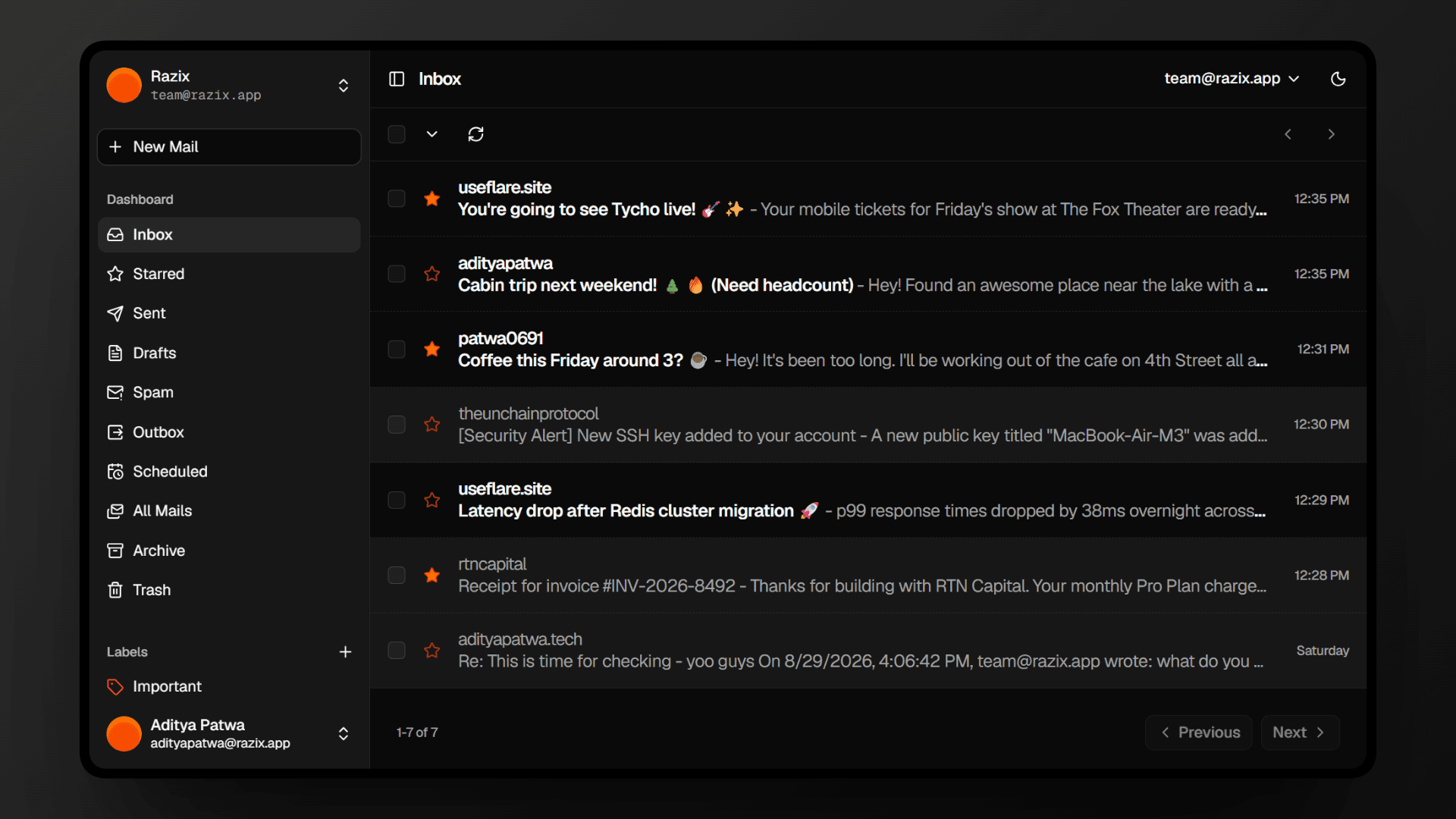
Razix is a unified multi-domain business email hub built on AWS SES and S3, designed specifically for this pattern. Instead of paying per mailbox, you get a flat-rate tier that covers a full portfolio of domains and mailboxes — support@, billing@, hello@, team@ — across everything you're building, in one modern dark-mode inbox.
Why it ranks #1 for startups:
- No per-seat tax — a 5-domain founder with 15 mailboxes pays one flat rate, not 15x a per-mailbox fee
- Built-in real-time SPF/DKIM/DMARC health monitoring, so deliverability issues surface before they hit a client's spam folder
- True bi-directional mailboxes (not fragile forwarding aliases) with full MIME parsing and threaded search
- Transparent, predictable overage pricing ($0.0015/email, $0.25/GB) instead of opaque bundling
Best for: Indie hackers, serial founders, digital agencies, and lean startups managing more than one domain.
2. Google Workspace — Best for Full Productivity Suite
Starting at ~$7/user/mo (Business Starter)
Google Workspace is still the default choice for a reason — Gmail, Docs, Sheets, Meet, and Drive in one bundle is hard to beat for a team that lives in Google's ecosystem daily.
The catch is the pricing model: it's per user, not per mailbox or domain, so shared/role addresses (support@, billing@) either need their own paid seat or get routed through group aliases with limited functionality. For a startup running one core domain and a small team, this is fine. For a founder running multiple domains or lots of low-traffic shared inboxes, the per-seat cost adds up fast — often $70–$150+/month for mailboxes that see a handful of emails a week.
Best for: Single-domain startups that need the full Google productivity suite, not just email.
3. Microsoft 365 — Best for Outlook/Exchange-Native Teams
Starting at ~$6/user/mo (Business Basic)
Functionally similar to Google Workspace, but built around Outlook, Exchange, and Teams instead of Gmail and Meet. If your startup is already standardized on Microsoft tooling (common in enterprise-adjacent or regulated industries), this is the natural choice.
Same limitation as Google Workspace: per-seat pricing that doesn't distinguish between an active founder mailbox and a low-traffic shared address, and no native concept of managing multiple domains under one flat rate.
Best for: Startups already embedded in the Microsoft ecosystem (Windows, Teams, SharePoint).
4. Zoho Mail — Best Budget Option for Single-Domain Teams
Starting at ~$1–$3/user/mo
Zoho Mail is the long-standing budget alternative to the Google/Microsoft duopoly, and it's genuinely cheap for a single domain with a handful of users. It includes calendar, docs, and a lightweight admin panel.
The trade-off is the experience: the interface feels dated compared to modern webmail clients, search indexing is noticeably slower, and DNS/domain setup is more manual than founders coming from modern SaaS tooling expect. It also doesn't offer a true flat-rate multi-domain model — you're still paying per user as you scale.
Best for: Cost-conscious single-domain startups that don't mind a less polished UI.
5. Migadu — Best Developer-Friendly Flat-Rate Alternative
Starting at ~$19–$59/year (varies by plan)
Migadu is one of the few providers that shares Razix's core philosophy: flat-rate pricing with unlimited mailboxes across your domains, rather than per-seat billing. It's popular in the self-hosting and privacy-conscious developer community.
Where it differs is UX and tooling polish — Migadu's interface and onboarding are noticeably more technical, and it lacks built-in, real-time deliverability guardrails (SPF/DKIM/DMARC alerts) in the way a modern SaaS dashboard would present them. It's a strong option if you're comfortable configuring DNS records yourself and don't need a polished, guided interface.
Best for: Technical founders comfortable with manual DNS configuration who want flat-rate multi-domain pricing.
6. MXroute — Best Rock-Bottom Pricing (If You Can Tolerate cPanel)
One-time/lifetime deals or low annual pricing
MXroute is popular in indie hacker communities for its aggressive pricing — often a fraction of what competitors charge for comparable mailbox counts. The trade-off is the interface: it's built on legacy cPanel-style infrastructure, which means manual server-level configuration, dated webmail clients, and a steeper learning curve for anyone not used to server administration.
Best for: Extremely budget-conscious founders who don't mind a dated, more hands-on setup.
7. ImprovMX / Forward Email — Best If You Only Need Forwarding
Free – ~$5/mo
These tools aren't full inbox platforms — they forward incoming mail from your domain to an existing inbox (like Gmail). They're free or nearly free, which makes them tempting for a brand-new domain.
The critical issue: forwarding breaks outbound authentication. When you reply from a forwarded address, SPF and DKIM alignment often fails, which is one of the most common reasons founders discover their client replies are landing in spam. These tools work for simple pass-through routing, not for genuine two-way business correspondence.
Best for: A brand-new domain that only needs incoming mail redirected — not for active client communication.
Full Comparison Table
| Provider | Pricing Model | Multi-Domain Support | Deliverability Monitoring | Best For |
|---|---|---|---|---|
| Razix | Flat-rate, unlimited mailboxes | Native, unified inbox | Built-in real-time alerts | Multi-domain founders |
| Google Workspace | Per-seat | Limited, per-domain add-ons | Manual | Full productivity suite |
| Microsoft 365 | Per-seat | Limited | Manual | Microsoft-native teams |
| Zoho Mail | Per-seat (cheap) | Limited | Manual | Single-domain budget teams |
| Migadu | Flat-rate | Yes (technical setup) | Manual | Technical/self-hosters |
| MXroute | Low flat/lifetime | Yes (cPanel-based) | Manual | Rock-bottom budget |
| ImprovMX / Forward Email | Free–low cost | Forwarding only | None (forwarding breaks auth) | Simple pass-through only |
How to Actually Choose
A few quick heuristics:
- Running just one domain, need docs/calendar too? → Google Workspace or Microsoft 365
- Running 2+ domains or products? → Razix (flat-rate avoids the per-seat multiplier)
- Comfortable with manual DNS setup, want the cheapest flat-rate option? → Migadu or MXroute
- Just need a placeholder inbox for a new domain, not real correspondence? → ImprovMX or Forward Email (but plan to upgrade before you start emailing clients from it)
Frequently Asked Questions
What is the cheapest business email hosting for startups? Free forwarding tools like ImprovMX are cheapest for basic redirection, but they aren't true inboxes and can break outbound email authentication. Among real inbox platforms, flat-rate providers like Razix and Migadu are typically cheaper than per-seat options like Google Workspace once you have more than a few mailboxes.
Is Google Workspace worth it for a small startup? It's worth it if you need the full productivity suite (Docs, Sheets, Meet) and are running a single domain with a small, active team. It becomes expensive quickly if you're managing multiple domains or several low-traffic shared mailboxes.
What business email hosting is best for founders running multiple products? Flat-rate, multi-domain platforms like Razix are built specifically for this — you get one predictable bill instead of stacking per-seat fees across every domain you launch.
Why is my business email going to spam? This is most often caused by misconfigured or broken SPF/DKIM/DMARC records, which is especially common with free forwarding tools that don't preserve authentication on outbound replies. Platforms with built-in deliverability monitoring, like Razix, catch this before it affects your sender reputation.
Start With the Right Foundation
Choosing your email provider early matters more than most founders expect — migrating mailboxes later means downtime, DNS changes, and risking your sender reputation mid-transition.
If you're running (or planning to run) more than one domain, skip the per-seat tax from day one.
Connect your first domain on Razix →
Flat-rate pricing, built-in deliverability monitoring, and one inbox for every business you're building.